Welcome to the rt tulley photography blogIt features photos, text, and poetry.June 23In-GENE-uity
I am thankful for "in-GENE-uity". If you haven't heard of that word before, it's because I made it up by combining ingenuity and GENE. I am thankful for genes and all they mean to life. DNA is quite amazing. Today's blog may be a little wordy and a lot controversial, but if you are interested, please bear with me.
I knew very little about DNA when my graduate student, Joanie, wanted to do her research on it. I told her jokingly that DNA had not been invented when I went to school. That was, of course, obviously not true because it had been invented several billion years ago and Watson and Crick had decoded its structure in 1953. But when I went to school there weren't really good ways to sequence genes. Now there are automated instruments that can do it fairly easily and the entire human genome has been sequenced. So, because of Joanie and a job I later took at LSU AgCenter, I had a crash course on DNA. Joanie did her Ph.D. research project on the importance of genes in heart disease risk,and went on to be technical director of the DNA unit at the Louisiana State Police Crime Lab. Very important stuff. She can determine who the bad guy was or who the bad guy wasn't.
But there is so much we really don't know about DNA. We do know that it works by coding for proteins. Proteins are the enforcers: the enzymes, the carrier proteins, the structural proteins, etc. DNA expression is very tightly regulated. Every cell contains the same DNA and yet each cell is expressed differently. When all works well, it is a magnificent system of checks and balances.
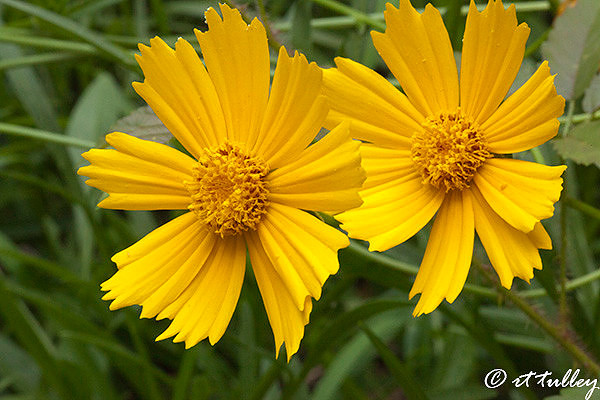
This is a photo of coreopsis flowers in my yard. It is a wildflower that grows in Louisiana. I am using it today as my photo because it ccarries a gene that makes it resistant to Roundup herbicide. When I was in charge of the Biotechnology Education for Students and Teachers (BEST) program at LSU AgCenter, I had to learn biotechnology, and this is one of the tidbits I picked up. It seems that when they sprayed Roundup along the sides of highways in Louisiana to kill weeds, they noticed that this little flower survived. The scientists at the AgCenter then isolated the gene that makes it resistant to Roundup and are trying to put it into various crops such as rice.
Biotechnology is the science which manipulates genes to improve products, make products, or help fight disease. I have mixed feelings about biotechnology from an ethical point of view, and I encouraged my students and teachers freely discussed these issues during our classes. But no matter what you believe, biotechnology is here and will probably stay. Most people probably don't know that the majority of the products you buy in the store have at least one genetically modified (GM) product in them. That may or may not be a bad thing. When you consider that the world's population is increasing at a very rapid rate and that fewer acres of land are being farmed, it is very important that the crops that we do produce are done so in a more efficient way than in olden days. Biotechnology offers a possible solution. One way is to produce Roundup ready crops in which herbicides can be applied to reduce the invasion by weeds which stifle the production of the crop. Another biotechnology product enables the crop to be disease and insect resistant, which allows for reduced application of insecticides and other toxic chemicals, thus reducing their environmental impact. One prouduct, golden rice, contains a gene to make beta carotene, the prevursor to vitamin A. This could theoretically eliminate vitamin A deficiency in third world countries.
Biotechnology is not new. Before the insertion of genes, people manipulated crops, ornamentals, and livestock to produce better products by crossing and by selective breeding. Biotechnology does the same thing but without the trial and error and much faster. Just as the development and widespread use of antibiotics led to 'superbugs' which were resistant to them, a problem facing biotechnologists is the evolution of resistant genes in natural weeds, bacteria, insects, etc., which allow them to overcome the effects of herbicides or the GM crop. Hopefully those problems will be solved in the future. Some people will say "It's not nice to mess with mother nature." Too late. Humans have been manipulating mother nature since the cave days.
I don't mind so much when plant or bacterial genes are altered. It is now fairly commonplace. Bacteria which have genes inserted are used widely for the production of important medical products and drugs such as insulin. Regulator genes placed into the bacteria are used to prevent these bacteria from being able to grow on their own outside the lab. These safeguards are in place so as to prevent any sceince fiction horror stories from happening in which one of these altered bacteria would grow rapidly out of control outside the lab and cause dire consequences. I have even more problems with the ethics of cloning and modifying animals so that they produce products for us. And then there's the ultimate fear, the cloning of people, which is quite scary. Just this last week, a frozen mastadon was found in Russia, which had intact preserved blood. There was talk of using the blood to clone the mastadon. Does that sound earily like Jurassic Park?
I do look forward to the day of medical genetic alteration to cure many of the genetic disases that make some people's lives very difficult, painful, and short-lived. Diseases such as sickle cell anemia, cystic fibrosis, muscular dystrophy, and perhaps cancer could, theoretically, be cured if there was a safe way to deliver and insert normal genes into a person afflicted with them. Scientists are proceeding very carefully on this to make sure there are no serious problems or bad side effects from these potential treatments. But maybe we will have gone too far if we start manipulating human genes to produce 'super humans' with higher intelligence, more athletic, better looking, or other traits that parents value. Imagine a couple going to a genetic doctor to order a child with blue eyes, ambidextrous, grows to be a 7 foot, basketball playing genious. Scary thought.
designer genes (thanks to my son John for the title)
i’d like to go to my designer gene store order a few genes that make life worth living for get rid of that fat grow a good foot taller run a lot faster tired of being smaller strong and good looking say goodbye to that gray hair anything you don’t want it doesn’t need to be there be the best golfer anyone could possibly be drive it 380 yards and straight and do it so effortlessly but mr. gene doctor i have a question for you when we can all buy the best designer genes will i not be just like you? © rt tulley
designer drugs 2
perhaps in the not too distant future dna they will have to test much like they now do for drugs performance enhancers and the rest give them a swab from the inside of your cheek and they will harvest your dna it’s designer genes they seek just to make sure you don’t have a genetic advantage so the ultimate performance enhancer it’s dna they will have to manage. © rt tulley
clone
i have a clone it looks exactly like me it talks exactly like me if you looked at him you’d think it is i you see but honestly i will say if the whole truth be known there is little similarity between me and my clone for what makes me me and ultimately makes him him is post dna processing that makes us nearly antonyms our experiences and how we handle them are what separates us that is my prized theorem here’s one last piece of information: that when it’s my clone you see be careful and remember my clone will never be me. © rt tulley June 22Memories
I am thankful for memories. It's funny how something so insignificant as a hat display will bring you into a series of fond memories that make you laugh.
We were on a day trip to Pontchatoula, Louisiana, a couple of weeks ago and were browsing in the old Pontchatoula train station, which had been converted into an arts, crafts, and antiques store, and came upon this red hat display, symbolic for the Red Hat Society. It brought back fond memories of my mother, when she told me the story about the Red Hat Society when I was asking about her assortment of red hats decorated with purple. The Red Hat Society was founded in 1997, probably unintentionally, by an artist named Sue Ellen Cooper, from Fullerton, California, who gave a friend an antique red hat for her 55th birthday, and attached the words to a Jenny Joseph poem which included the lines "When I am an old woman I shall wear purple; With a red hat that doesn't go and doesn't suit me." As they say in this internet age, it went 'viral' and the rest is history. According to Wikipedia, as of 2011, there were more than 40,000 chapters in the world. I like that the women in this social group embrace silliness and poke light hearted fun at their advancing age. Whenever I see a red hat I will forever more think of my mother and smile.
red hat
red hat, purple hat all those fine and fancy hats wish i could see a hundred hat wearing aristocrats sipping coffee and downing chamomile tea smiling and laughing comfortable as can be. © rt tulley
June 21Golf Course Architecture
I am thankful for golf courses and their design, ie., golf course architecture. I may possibly love this more than the game itself, although you can't have one without the other. My family will affirm that nearly everywhere we go, I will see a place and I remark "This would be a great place for a golf course." And in my mind, I picture a hole or two that would fit perfectly on that spot. I have a great admiration for the masters of golf course architecture: Donald Ross, Tom Fazio, Robert Trent Jones, Rees Jones, Pete Dye, Jack Nicklaus, Arnold Palmer, and many others. I have nothing but praise for architects who can incorporate beauty, strategy, and challenge into a golf course.
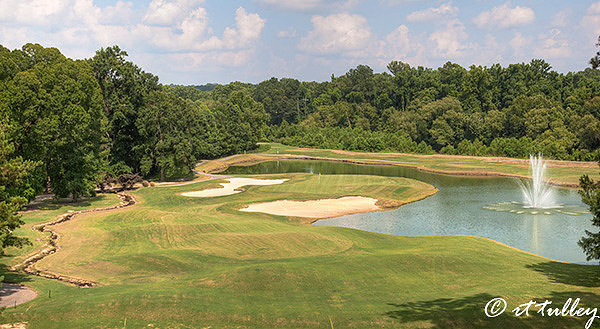
Continuing my series on The Bluffs, this is a photo of the seventeenth hole there, taken from the tee. This course, designed by Arnold Palmer, makes fabulous use of the topography and natural beauty of the land that John James Audubon traversed in creating his Birds of America series. This hole is a par 3 that drops 60 feet from tee to green and plays as long as 231 yards from the championship tee and as short as 128 yards from the red tees. It is a breathtaking hole, which has a large bunker guarding the front and another to the left of the green. Of course, the lake is a prominant feature which wraps around the green in front and around the back. The green is large enough so that one may try to avoid the lake by trying to hit to the left side or aim left with a slight fade. Those that bail out by hitting left and short have to contend with the little stream to the left. But the ultimate difficulty in the hole, for the uninitiated, is trying to determine what club to hit because of the extreme elevation change. The drop in elevation will require less club than would normally be hit for the same distance. I used my 180 yard 3 hybrid for a 200 yard shot but ended up just short of the green in the bunker in front. I like the way Palmer incorporated this extreme elevation change and built a lake into which the green forms a peninsula.
golf course
there’s a golf course beyond the far horizon where the holes are all birdie-able yet fair silk smooth greens and undivoted fairways
but there are hazards if you get in trouble you’ll languish there bogies and double bogies perhaps more but if you control your shots and play your game you’ll rise up and win on the golf course of celestial fame. © rt tulley
i am a golf course
i am a golf course of beauty and treachery i eat golf balls in my solemn reverie they come to show their mastery over me but they leave bent, broken, and unfree i catch them with my rough i swallow them in my water i bury them in my sand i make them my fodder
there are those the pretenders i see those that come and think that they will conquer me i only offer my challenge then laugh in their faces for they end up falling to their eternal disgraces they bow in humble reverence to each of my eighteen flags symbols of the demolished shots of inept sticks in their bags i do allow a few triumphs for these old men for those minor victories do keep them coming back again for more anguish and more defeat at my hands they will soon meet
but on some days along comes someone who will jump upon my back and break me for fun with control and skill he’ll play me right he’ll keep away from my treachery he’ll not waver in my sight he will own me as he precesses around he will master my lawn as he preys upon my ground i celebrate with him in this great success for he has conquered me in this, his greatness. © rt tulley
June 20Hills
I am thankful for hills. Even though I have always been a "flatlander", I have always loved rolling hills. To me they are just so beautiful and the perfect place to put a golf course. The presence of hills on a golf course adds another variable in the third demension that has to be accounted for when taking your stance, lining up your shot, and adjusting your swing to the land.
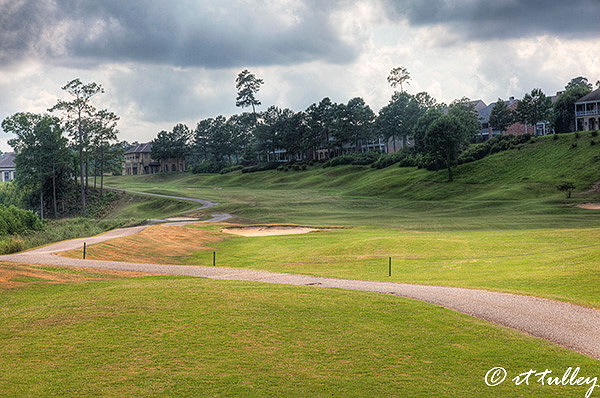
This photo is the eighteenth hole at The Bluffs in St. Francisville, taken near the tee. The course is built on some of the most beautiful tree lined rolling hills anywhere in Louisiana. The eighteenth is a faily short dogleg left par five which runs along the bluff overlooking Thompson Creek to the left and rises uphill all the way to the green. The houses to the right have a gorgeous view on the bluff overlooking the hole and the creek.
the hills are alive (with apologies to Julie Andrews)
the hills are alive with the sound of beauty whispering in your ears of your heartfelt duty rise and fall with the flow of the earth reminding us evermore of our place of new birth. © rt tulley June 19The High Road
I am thankful for the high road. The high road represents the morally "high ground", doing the right things and living the good life, whereas the low road represents the easy life filled with wrong decisions. The history of low road versus high road goes back to the days when the low road represented the shortest and perhaps easier trek but fraught with the possibility of getting "stuck in the mud". The high road is a further and more difficult road but is generally "high and dry", so ultimately it may be wiser and safer to take the high road. Low road versus high road is sung about in the song Loch Lomand: "You'll take the high road, and I'll take the low road; And I'll be in Scotland before you." Of course, the low road is so very tempting and I personally have not always avoided it. But in the long run, the high ground is much more rewarding.
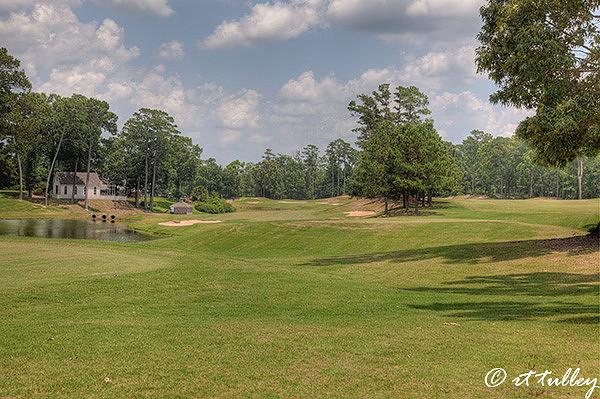
I don't know if Arnold Palmer had the low road versus high road metaphor in mind when he designed the beautiful ninth hole at The Bluffs in St, Francisville, Louisiana, but I believe the hole is the perfect metaphor for it. The par five hole has two fairways, the one on the right is 10-15 feet higher than the lower one on the left. The left fairway is shorter, but riskier, than the right fairway. A lake follows the left fairway the length of the hole and then a shot of nearly 200 yards over water is required to reach the green. The lower fairway tempts those interested in going for the green in two. If you hit to the right fairway, there is a wider fairway, no water has to be crossed, but the route is longer, generally taking three shots to get to the green. It's interesting also, that The Bluffs has placed a small church chapel on the ground overlooking the low ground. Perhaps to save those souls who have stayed to the low ground!
Being tempted by a life of bad decisions and a morally indescript life which may seem easier on first look and may appear to hold the bigger rewards, requires that more "hazards" have to be navigated and carries with it the possibility of self destruction. The morally high ground may be more difficult at first glance but generally results in better outcomes.
I played at The Bluffs last week for the second time (last played more than a decade ago) and thoroughly enjoyed the golf course. It is absolutely gorgeous and is among the best golf courses in the state. In playing the ninth hole, I chose to take the "high road" but, unfortunately, I hooked my drive and my ball ended up hanging on the edge of a sand bunker in the left fairway. With an awkward stance, I had no choice but to hit an iron down the fairway. Then, looking at a 225 yard shot over water to the green, I chose to head back to high ground by going over the trees to the right fairway rather than risk the drink. Perhaps it is possible to recover from a journey begun on the "low road". I was on the green on my fourth shot. Not great, but better than the alternative of a ball in the water and a penalty stroke.
low road high road
low road high road which one to take a very tough decision for one to make easy to choose the road that’s low difficult to navigate for high to go but the road less traveled the better pick less worn down and trampled but much less slick. © rt tulley
|