
March 25

Vision

I am thankful for vision. It is not only the ability to see with your eyes but the ability to see with your mind, which is a much more difficult thing to do. To see things that are not obvious, are hidden, or not there at all takes training and attention. To be able to visualize something that isn't there, ie, see possibilities, really takes something extra.
Vision is crucial for photographers. You have to visualize and think in your brain what you want the photo to look like. You then have to use the tools in your camera and the result of your training to make it look the way your vision ses it. If your vision calls for everything to be in focus, you have to use a narrow aperature. If it calls for a blurred background you go for a wide aperature. Shutter spead is important for stopping moving things in time or blurring them. Then there is knowing how to compose the photo and which lens to use. There are a myriad number of things that you must see in your mind's eye and then to mechanically construct that vision. Sometimes we get lucky with a photo that didn't take much planning. Other times, careful vision and planning results in success. Then there are the times when the finished photo never touches you the way you "saw" it. Oh well. That's when you go back to the drawing board. But I think my vision has improved over the years and there are fewer failures. But I think there will always be failures. I took a workshop with C.C. Lockwood, Louisiana's famous wildlife and scenic photographer, who told me that the majority of his photos are thrown away.
Sometimes, in spite of carefully composing the photo and visualizing it, when you get back to look at the finished photo you discover something there that you didn't notice at the time. Like when someone walked into your field of vision that you hadn't noticed at the time, or when an ugly eyesore reared its ugly head in your beautiful scenic photo. Or you notice in the photo on careful examination that the man in the car you were photographing was giving you an obscene gesture (that actually happened to me)!
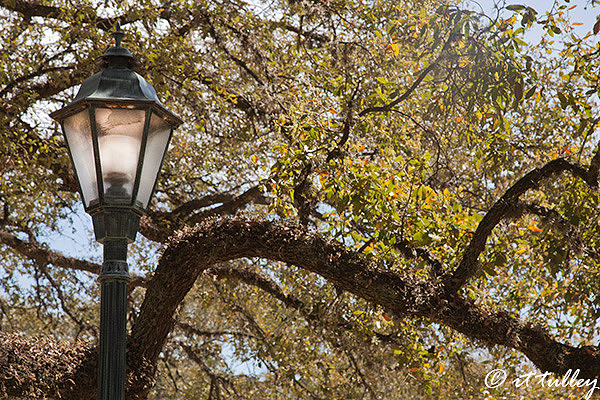
In this photo, I am using the metaphor of being able to see represented by a lit lamp. It takes light to be able to see in the darkness - just as it takes a special light inside your brain to see possibilities and things that may not be obvious. I took this photo in the Memorial Oaks Grove at LSU of a lamp and one of the oaks in the grove. I cheated a little by using Photoshop to light the lamp (by using the dodge tool to underexpose the lamp). Even though it was daytime, I think this effect gave the lamp a little extra.
vision
it takes good eyes or glasses
to see what is really there
but to imagine the unseen
takes a mind with special flair
but there are those of the opinion
and this is their humble diagnosis
if you see things that aren’t there
you’re either drugged or have a psychosis.
© rt tulley